
Tournament organizers used to accept scheduling headaches as part of the job — the printed brackets, the last-minute court swaps, the phone calls at 6 a.m. about a rained-out match. That era is fading fast. Automated match planning is reshaping how events of every size are run, and the pace of change over the last few years suggests this shift is only getting started. What began as a convenience for large professional circuits is now filtering down to weekend club tournaments and school leagues, changing what players and parents expect from even the smallest events.
From Spreadsheets to Smart Systems
A decade ago, even mid-sized tournaments relied on manual draws and paper-based court assignments. Today, AI-powered tournament management software handles the same job in a fraction of the time, cross-checking player availability, court capacity, and format rules simultaneously instead of one spreadsheet tab at a time. The result is fewer errors and far less scrambling on event day.
Why Predictive Scheduling Is the Next Step
The next wave of tools goes beyond simply automating what humans already did by hand. predictive scheduling uses historical match-length data, weather patterns, and player performance trends to forecast delays before they happen, giving organizers a buffer instead of a crisis. A match that typically runs long on clay, for instance, gets an automatic time cushion built into the draw, so the schedule stays realistic instead of falling apart by the third round.
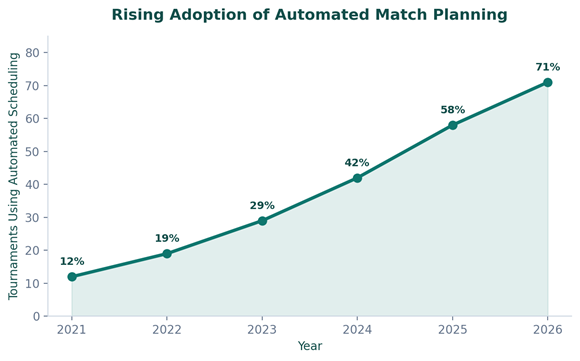
Adoption numbers reflect this shift clearly. What started as a niche feature for large professional circuits has become mainstream even at the club and academy level, as more organizers realize that dynamic scheduling technology pays for itself within a single season through saved staff hours alone.
Weather, Withdrawals, and Real-Time Adjustments
Rain delays and last-minute withdrawals have always been the two biggest disruptors of a tournament day. Modern platforms now respond to both automatically, shifting matches, notifying players, and rebalancing courts without anyone touching a phone. This kind of dynamic scheduling technology turns what used to be a two-hour scramble into a process that resolves itself in the background while staff focus on the event itself.
Turning Match Data Into Better Decisions
Every match played inside one of these systems generates data — how long matches actually run, which courts see the most conflicts, where players tend to arrive late. Feeding that back into future draws is where data-driven scheduling earns its keep, letting organizers plan next season's event around real patterns instead of guesswork carried over from the year before.
This same data layer is also starting to connect with other parts of event management, from registration systems to payment processing and results reporting. Once scheduling, entries, and communication all pull from the same dataset, organizers stop reconciling three different spreadsheets after every round and start trusting a single source of truth for the whole tournament.
Scheduling That Travels With You
Access matters as much as intelligence. Cloud-based tournament software means a director can approve a bracket from a phone in the parking lot, and a player can check their next match time from anywhere, without ever needing to find the printed sheet pinned to a noticeboard. This kind of always-on access has quietly become the expectation rather than the exception, and tournaments that still rely on a single printed master schedule increasingly stand out for the wrong reasons.
Where Platforms Like Tenniskhelo Fit In
Tennis-specific platforms are leading much of this change because the sport's format — individual matches, variable court counts, weather sensitivity — benefits so directly from automation. Tenniskhelo is one such smart tournament management app, built around the idea that organizers should spend their energy on the event itself rather than the logistics holding it together.
What Comes Next
Looking ahead, expect scheduling tools to lean further into personalization — draws that account for individual player rest preferences, travel time between venues, and even broadcast windows for featured matches. Next-generation scheduling tools are already being tested by larger circuits, and the features that prove useful there tend to trickle down to club-level software within a season or two.
The bigger picture is hard to miss. Every tournament that switches from paper brackets to automated systems raises the bar for what players and spectators expect from the next one. The future of tournament scheduling isn't a distant concept anymore — it's already running quietly in the background of the events happening this weekend, and the organizers who adopt it early are the ones setting the pace for everyone else. The tournaments that wait too long to make the switch may find themselves explaining, once again, why the schedule fell apart after a two-hour rain delay.